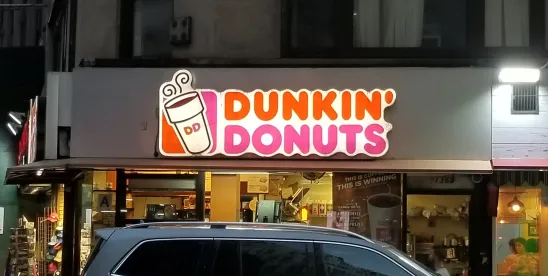
A recent New Jersey Appellate Division decision offers a clear reminder for commercial real estate practitioners: the plain language of an easement deed controls its duration, and the doctrine of relative hardship will not save a party that knowingly assumed the risk of an expiring easement.
Background: Thirty Years of Dunkin’ Donuts Drive-Through
In 1993, D.D. Toto, L.P. leased a parcel of land in Totowa, New Jersey (Lot 5) from landowner Carmine Curcio for a twenty-year term, with two five-year options, to operate a Dunkin’ Donuts restaurant. To support the drive-through, D.D. Toto also obtained a deed of easement from Madeline Freda, the owner of adjacent Lot 4, granting ingress and egress across a twenty-foot strip of her property.
The easement deed provided that the easement “shall run concurrently with a Lease between Carmine Curcio and D.D. Toto . . . and shall be for twenty (20) years, with two (2) five year options,” and included a payment schedule ending on July 31, 2023. The deed was recorded in the land records.
Over the next three decades, ownership of the properties changed. In 2008, MC-FAM Property Rte. 3, LLC purchased Lot 4. Its member, William McEntee, acknowledged that a thirty-year easement burdened the property for the Dunkin’ Donuts drive-through lane. In 2013, Curcio entered into a new lease of Lot 5 with Red Rose Investors LLC, which did not reference the 1993 lease or the easement deed. In 2015, Red Rose subleased the property to JF-Totowa Donuts, Inc., and JF-Totowa assigned any interest it held in the easement deed to Red Rose.
The assignment documents did not address or extend the easement’s expiration date. As JF-Totowa’s president later admitted, the termination date “was apparently overlooked.”
The easement expired on July 31, 2023, but the drive-through continued to operate.
The Litigation
In July 2023, Red Rose filed suit against MC-FAM asserting three claims:
- Easement by deed language: The deed should be interpreted to tie the easement’s duration to any Dunkin’ Donuts operation on Lot 5, rather than to the original 1993 lease.
- Doctrine of relative hardship: Even if the easement expired, equitable principles required its extension because the loss of the drive-through would impose disproportionate hardship.
- Prescriptive easement: Decades of open and notorious use created an independent easement over a rear passage between the lots.
MC-FAM counterclaimed, seeking a declaration that the easement had expired, an injunction requiring the premises to be vacated, cancellation of the recorded deed, and damages for the fair-market rental value of the post-expiration use.
The Trial Court’s Rulings
The Chancery court granted summary judgment to MC-FAM on the first two claims. It held that the easement “expired by its own terms” and had not been extended. While acknowledging the hardship to the Dunkin’ Donuts business, the court declined to alter the parties’ agreement.
The court also dismissed the relative hardship claim, finding the doctrine inapplicable under the circumstances.
The prescriptive easement claim proceeded to trial on September 30, 2024, but was dismissed at the close of Red Rose’s case due to insufficient evidence of open and notorious use for the required thirty-year period.
On February 3, 2025, final judgment was entered. The deed was cancelled, JF-Totowa was ordered to vacate the easement area by May 1, 2025, and MC-FAM was awarded damages of $1,048.33 per month for the period from August 2023 through April 30, 2025.
The Appellate Division’s Analysis
Easement Duration: Plain Language Controls
The Appellate Division applied established principles of contract interpretation. When an easement is unambiguous, courts look only to the language of the instrument. Extrinsic evidence, including testimony from the original negotiator, is considered only if the language is ambiguous.
Here, the deed clearly tied the easement to the specific lease between Curcio and D.D. Toto, included a payment schedule ending in 2023, and defined a term matching the lease and its options. The court noted that if the parties intended a longer duration tied to ongoing operations, they could have stated that explicitly.
Relative Hardship: No Relief for a Known Risk
The doctrine of relative hardship allows a court to deny injunctive relief or award damages instead when enforcement would impose a burden far greater than the benefit to the property owner. Courts typically apply the doctrine only where there is a mutual mistake or inequitable conduct.
The Appellate Division found neither. The easement was recorded and known to all parties. The issue arose from Red Rose’s and JF-Totowa’s failure to account for the expiration date in later transactions. MC-FAM, by contrast, had anticipated the easement’s expiration and explored development opportunities for Lot 4.
Damages: Deference to Trial Court Findings
MC-FAM challenged the damages award as insufficient, arguing that its expert’s valuation should have been adopted. The Appellate Division deferred to the trial court’s credibility determinations, noting that MC-FAM’s expert lacked relevant experience and that his analysis was flawed. The trial court reasonably relied on Red Rose’s expert with adjustments.
Key Takeaways for Practitioners
- Easement terms are strictly enforced. When a deed ties duration to a specific lease, the easement ends with that lease, even if the business continues.
- Successors inherit rights as written. A successors and assigns clause transfers existing rights but does not expand the duration of an easement.
- Relative hardship has limited application. Financial impact alone is not enough. The doctrine generally requires mutual mistake or inequitable conduct, not a party’s failure to review recorded documents.