
We didn’t get an Apple Car, but we did get the Ferrari Luce as insight to an electric future for performance.
Ferrari is marking a “new chapter” with the all-electric Luce. The Italian automaker first let on that it was developing a new EV late last year, but now we’re looking at the formal production version. And it’s something to behold, to say the very least. With 1,035 horsepower from its quad-motor setup, a 0-62 mph time of 2.5 seconds and a top speed of 193 mph, there’s still plenty of performance on tap with this new model. That’s not what will likely divide people most, though, so let’s just get into what will.


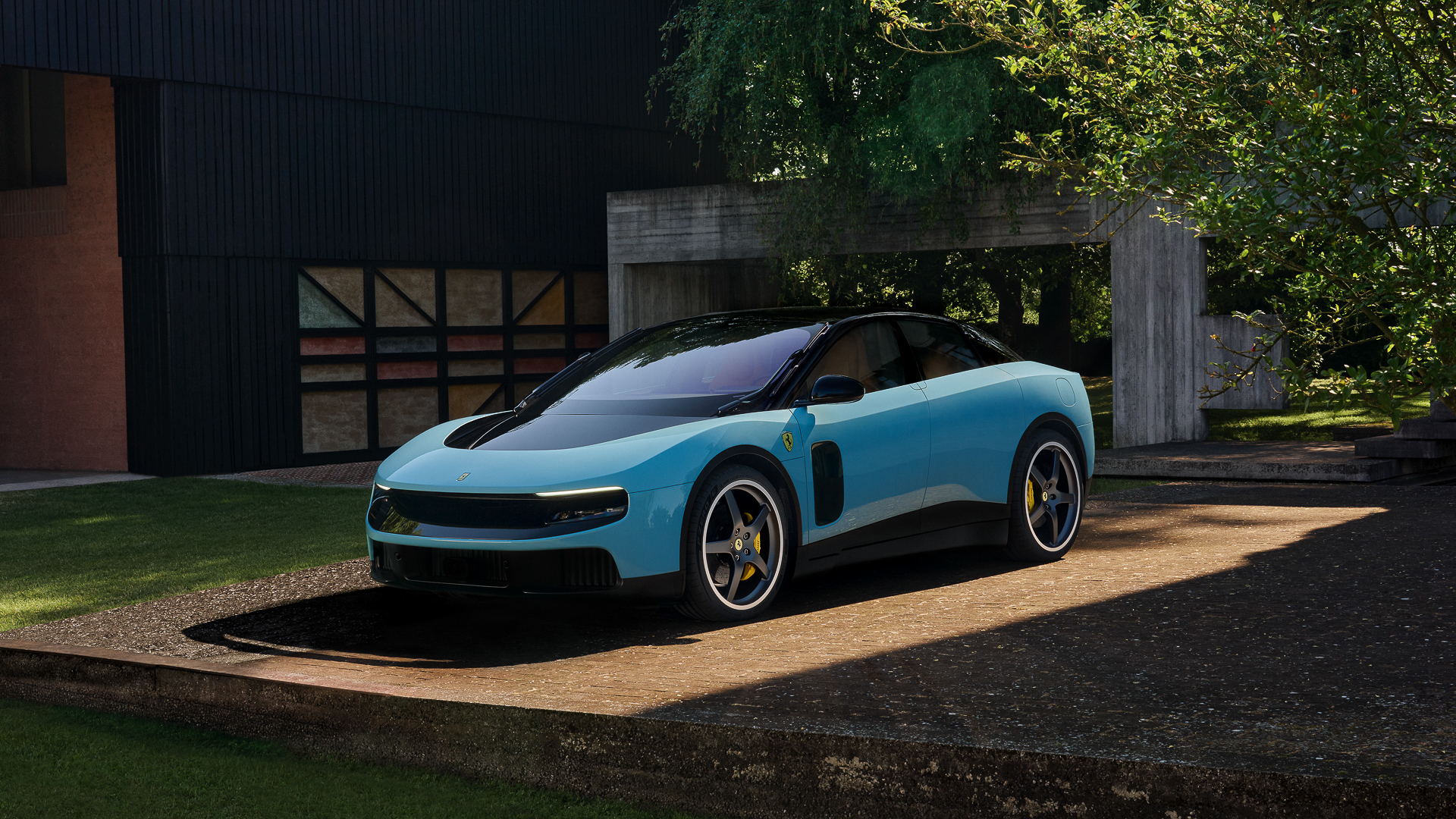
We’re used to pretty extreme styling with Ferrari’s most recent offerings like the F80. The Luce takes things to a completely new level, though, mainly by way of its electric architecture. That freed up designers to step out from traditional styling cues and form factors…and boy did they ever take that directive to heart. This is not an in-house Ferrari design, but rather a product of American design collective LoveFrom, based out of San Francisco. The firm is under the lead of Sir Jony Ive, British-American design guru who worked with Apple under Steve Jobs and whose company has been making waves for the past six years with firms like Airbnb and OpenAI, as well as Ferrari.
At 197.9 inches long, the new Ferrari Luce is about two inches shorter than the Purosangue, which also made waves as a contentious offering in the brand’s lineup as an SUV. At 60.8 inches tall, though, the Luce is about two inches shorter overall, so that all-aluminum body does have a bit of a lower, sporty aesthetic, from some angles at least.
If you’re wondering about that front end — and I don’t blame you one bit for that — the key player is the same as its been for every other EV out there (performance or otherwise): aerodynamics. Thanks to the dogged focus on “smooth, continuous and uninterrupted” surfaces, the Luce packs a lower drag coefficient than any other Ferrari to-date of 0.254. Not that range is a particularly high priority for performance-minded buyers, but that figure along with the 122-kW battery pack also enables this 4,982-pound car to drive up to 330 miles using the WLTP standard. As far as that translates to American-typical EPA ratings…we’re looking at somewhere in the 275-mile range.

The Luce’s interior is much more restrained than you might think, even being an EV.
As likely as the exterior angles and design is likely to split opinions (and how about those faux-F40 taillights?), the Luce’s interior brings some more classic touches to the table. You do still get the modern screens, of course, but there are only two. You also get some actual physical controls on the center stack, as well as a relatively simple steering wheel layout with a couple banks of switches below the turn signal buttons. Those control some of your basic functions, as well as the traction control on the right and the drive modes.
But there’s one major elephant in the room since we’re talking about an electric Ferrari here. What about the sound? Well, the e-Manettino, a switch next to the five-position Manettino (drive mode selector), you can set up three different sound levels. “Range” is the typical near-silent EV experience, “Tour” give you some noise and “Perfo” pipes in the most noise, both inside and outside the car. The launch control handle — and yes, it is an overhead handle — is arguably the coolest part of the Luce’s design.
On the practicality front, the new Ferrari Luce is also the first under the Prancing Horse to actually seat five people. The Purosangue, by contrast, only seats four. Under the liftgate, there’s also a 21.1 cubic feet (597 liter) cargo area, giving the Luce the largest trunk ever fitted in a Ferrari too.


Even being a Ferrari, those numbers are…not the most we’ve seen from an EV.
Unlike the styling, both the battery pack and the four electric motors with the pair up front making 282 horsepower and the rear two making 831 horsepower, are designed in-house by Ferrari. The Luce also gets an 800-volt electrical architecture to support up to 350 kW fast-charging, so any buyers aren’t going to be sitting around on the road or at the charging stations.
Even being Ferrari quick, though, EVs are in an entirely different league…at least on paper. The Luce throws down with the 1,020-horsepwer Model S Plaid, but the figures don’t quite mach the 1,234-horsepower Lucid Air Sapphire. Hypercars like the Rimac Nevera R manage more than double the Luce’s output.
Sure, the new Ferrari Luce may not cost nearly as much as the Nevera, but it’s not exactly cheap either. The car will hit European roads later this year, with a price tag of around 550,000 Euros. That means a price tag of $640,000, or about $150,000 or so more than a Purosangue brand-new. After its European launch, the Luce will go on sale here in the U.S. about a year from now (and formal pricing hasn’t been announced, so it could be a bit more or less than the direct exchange rate would suggest).
There’s no denying the new Ferrari Luce is a polarizing prospect in so many different ways, and not just how it looks. In a similar vein as the Purosangue, can folks actually come around to accept the idea of an electric Ferrari? Is it going to be anywhere near as desirable as, say, the Roma or Amalfi or the 12Cilindri, just to name a few? As much as I can feel some of you out there shouting some variation on “**** no!” as you read this, I’m curious to see those still who might actually give it some thought.
From CEO Benedetto Vigna, you get a bit of a sense where the company’s thinking with this one. “In line with our belief in technological neutrality, we are the first in the world to combine fully electric, hybrid and combustion architectures for sports cars. We have not limited ourselves to innovation in powertrains; with Luce, we have launched a whole new segment in our range.”
That’s a direct shot to Ferrari’s luxury rivals, all of whom are pulling back their headlong charge toward EVs. Lamborghini, for instance, dropped its plans for the electric Lanzador, making it a plug-in hybrid instead after saying interest in an EV was “near zero”. Aston Martin pushed back its EV until at least 2030, if that doesn’t get scrapped entirely. Bentley pulled back its former ambitious electric rollout. Are you spotting a pattern here?
By launching the Luce now, Ferrari does get to say it at least had the stones among the “legacy” sports car manufacturers to actually drop a fully electric model. I don’t know how far that claim will go in winning over any skeptics…but we’ll see how many folks actually clamor to take the plunge, and the hit to their wallets, by picking up a Luce.