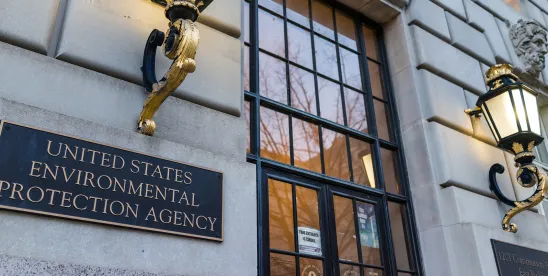
On May 8, 2026, the U.S. Environmental Protection Agency (EPA) withdrew its 2024 proposed rule defining hazardous waste applicable to corrective action for releases from solid waste management units. The proposal would have amended EPA’s Resource Conservation and Recovery Act (RCRA) regulations to expressly apply the broad statutory definition of “hazardous waste,” rather than the narrower regulatory definition, to corrective action requirements for permitted hazardous waste treatment, storage, and disposal facilities (TSDFs). EPA stated that, after reviewing public comments, it concluded the proposed amendments could “complicate[], rather than contribute[] to, efficient implementation of corrective action.”
Background on the Proposed Rule
EPA stated that its February 2024 proposed rule was intended to “clarify” that corrective action authorities under RCRA Sections 3004(u), 3004(v), and 3008(h) extend beyond wastes formally listed or identified as hazardous under EPA regulations and encompass substances meeting the broader statutory definition of hazardous waste under RCRA Section 1004(5). The RCRA corrective action authorities provide EPA with a mechanism to require remediation of releases of “hazardous wastes” or “hazardous constituents” from solid waste management units (SWMUs) at permitted or interim-status TSDFs. While the RCRA statute defines hazardous wastes broadly as solid wastes that pose a substantial hazard to human health or the environment when mismanaged, RCRA Section 1004(5), 42 U.S.C. § 6903(5), the regulations promulgated to implement the statutory corrective action authorities utilized the longstanding regulatory definition of hazardous wastes, which encompasses only wastes listed as hazardous under the regulations or that exhibit one of the characteristics specified in the rules. See 40 C.F.R. 260.10; 40 C.F.R. 261.3(a) (regulatory definition of hazardous waste). “Hazardous constituents,” which EPA also references in the corrective action regulations, are understood to mean the constituents listed in Appendix VIII to 40 C.F.R. Part 261. See, e.g., 40 C.F.R. 264.101 (requiring TSDF “owner or operator” to “institute corrective action as necessary to protect human health and the environment for all releases of hazardous waste or constituents from any solid waste management unit at the facility”).
The withdrawn proposal would have:
- Amended the definitions of “hazardous waste” in 40 C.F.R. §§ 260.10 and 270.2 as they apply to corrective action requirements;
- Added RCRA corrective action authorities (Sections 3004(u), 3004(v), and 3008(h)) to the list of statutory provisions in 40 C.F.R. § 261.1(b)(2), which describes when the statutory definition of solid and hazardous waste, as opposed to the more limited regulatory definition, dictates the scope of EPA’s authority; and
- Potentially expanded EPA’s ability to require investigation and remediation of emerging contaminants, including certain PFAS, through the RCRA corrective action program, even where those substances are not formally listed as hazardous waste or hazardous constituents under EPA regulations.
See Beveridge & Diamond’s February 8, 2024 News Alert for an overview of the withdrawn proposed rule, as well as the related EPA proposal, Listing of Specific PFAS as Hazardous Constituents. At the time, both proposals represented a potential major expansion of EPA and state environmental agencies’ authority to regulate PFAS and other emerging contaminants.
EPA’s Basis for Withdrawal
In the withdrawal notice, EPA explained that the proposed revisions were unnecessary because existing corrective action authorities and permit mechanisms already provide sufficient tools to address releases that may pose risks to human health or the environment.
EPA also agreed with commenters that the proposal could create confusion regarding:
- Which substances would be subject to corrective action;
- What materials qualify as “hazardous waste” for permitting and reporting purposes; and
- Which units may constitute “solid waste management units” subject to corrective action obligations.
The Agency specifically noted that uncertainty about the identification of wastes subject to corrective action could complicate permit application and information submission requirements under 40 C.F.R. § 270.14(d)(3).
EPA further emphasized that the withdrawal does not alter existing corrective action regulations or EPA’s longstanding interpretations of its corrective action authorities, which EPA has stated are based on the statutory definition of hazardous waste.
Implications for Regulated Facilities with Corrective Action Requirements (Permitted TSDFs)
Although the 2024 proposed rule would have directly addressed EPA’s ability to require investigation and remediation of emerging contaminants, such as PFAS, through the RCRA corrective action program, EPA’s May 8 withdrawal notice is silent regarding such substances. Instead, EPA asserts that “to the extent that releases of other RCRA statutory hazardous wastes and constituents have occurred and present a risk to human health or the environment, EPA has other tools to require clean up in RCRA permits,” including an “omnibus” authority under RCRA that “requires that permits contain such terms and conditions as the Administrator determines necessary to protect human health and the environment, including any necessary conditions requiring an owner or operator to address releases of substances that are not hazardous waste or hazardous constituents under the regulations.”
At the same time, however, in EPA’s January 2024 “Economic Assessment for the Definition of Hazardous Waste Applicable to Corrective Action for Releases from Solid Waste Management Units” (“2024 Economic Assessment”), which the Agency also cited in the withdrawal notice, EPA noted that the proposed rule could reduce “the likelihood of challenges to permit conditions for corrective action that address releases of substances not listed or identified as hazardous waste in the regulations.” In light of EPA’s acknowledgment of potential litigation risk in this area, facilities pursuing permit renewals may wish to evaluate the legal basis for corrective action terms and conditions addressing contaminants that are not expressly regulated as hazardous wastes or hazardous constituents under RCRA (e.g., perfluorinated compounds), and may wish to push back on the inclusion of such terms.
Relatedly, the 2024 Economic Assessment also stated that EPA expected that “increased corrective action activity will be supported principally not by this rule, but by the companion [proposed] rule listing a set of those substances as hazardous constituents in Part 261 Appendix VIII.” EPA has not yet taken final action on that companion proposal. However, TSDFs with potential perfluorinated compound contamination should closely monitor whether EPA’s companion Appendix VIII rulemaking will be finalized, modified, or withdrawn. EPA’s Spring 2025 Regulatory Agenda (the latest available) indicated that it anticipated final action on the hazardous constituent listing proposal in April 2026.
Finally, as noted above, EPA’s withdrawal emphasized that it retains other statutory authorities to address releases that may present risks to human health or the environment, including authorities under RCRA Sections 7003 and 3013, which provide the Agency mechanisms, respectively, to address imminent and substantial endangerments caused by handling of solid or hazardous wastes, and to require monitoring, testing, and analysis at facilities where hazardous wastes are present or have been released and present a substantial hazard to human health or the environment. Use of these authorities, however, generally requires EPA to develop a robust administrative record and satisfy the statutory elements necessary to support Section 7003 or Section 3013 actions.
Elizabeth Richardson, Lynne Davies, and Timothy J. Sullivan contributed to this article