Article Summary
- BMW Group Chief Designer Adrian van Hooydonk confirmed ALPINA will have its own dedicated design team, V8 engines, and a top speed target of around 300 km/h.
- The new ALPINA is positioned as deliberate anti-M: fast but visually restrained, with subtle exterior cues and an interior-first personalization philosophy.
- Van Hooydonk left the door open to standalone ALPINA models not derived from any existing BMW platform — a significant departure from the brand’s tuner roots.
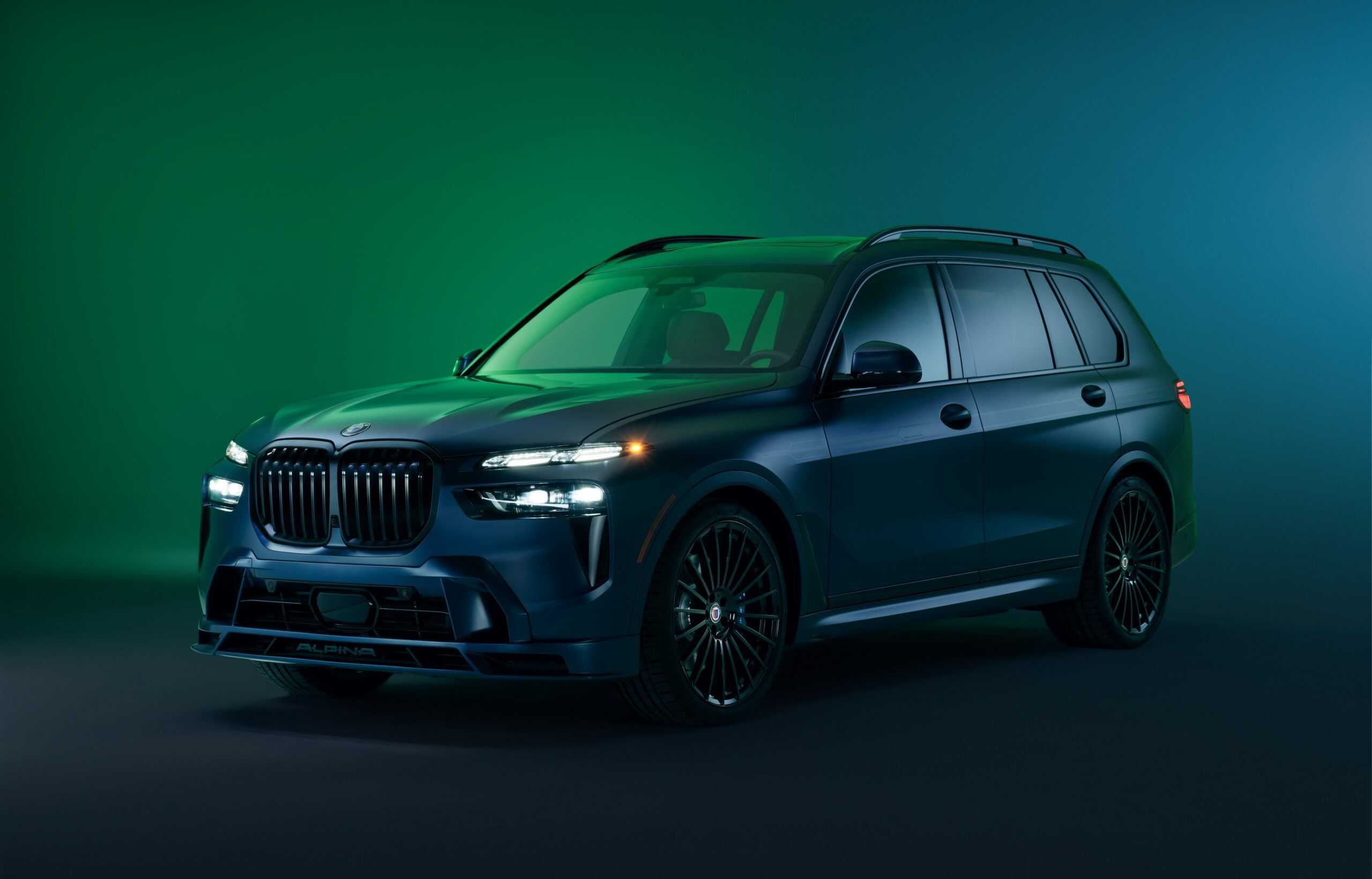
There’s a version of this story where BMW acquires ALPINA, sticks the blue-and-green badge on a few 7 Series variants, charges a premium for hand-stitched leather, and calls it a day. That’s the cynical read. It’s also, according to BMW Group Chief Designer Adrian van Hooydonk, exactly what they’re trying not to do.
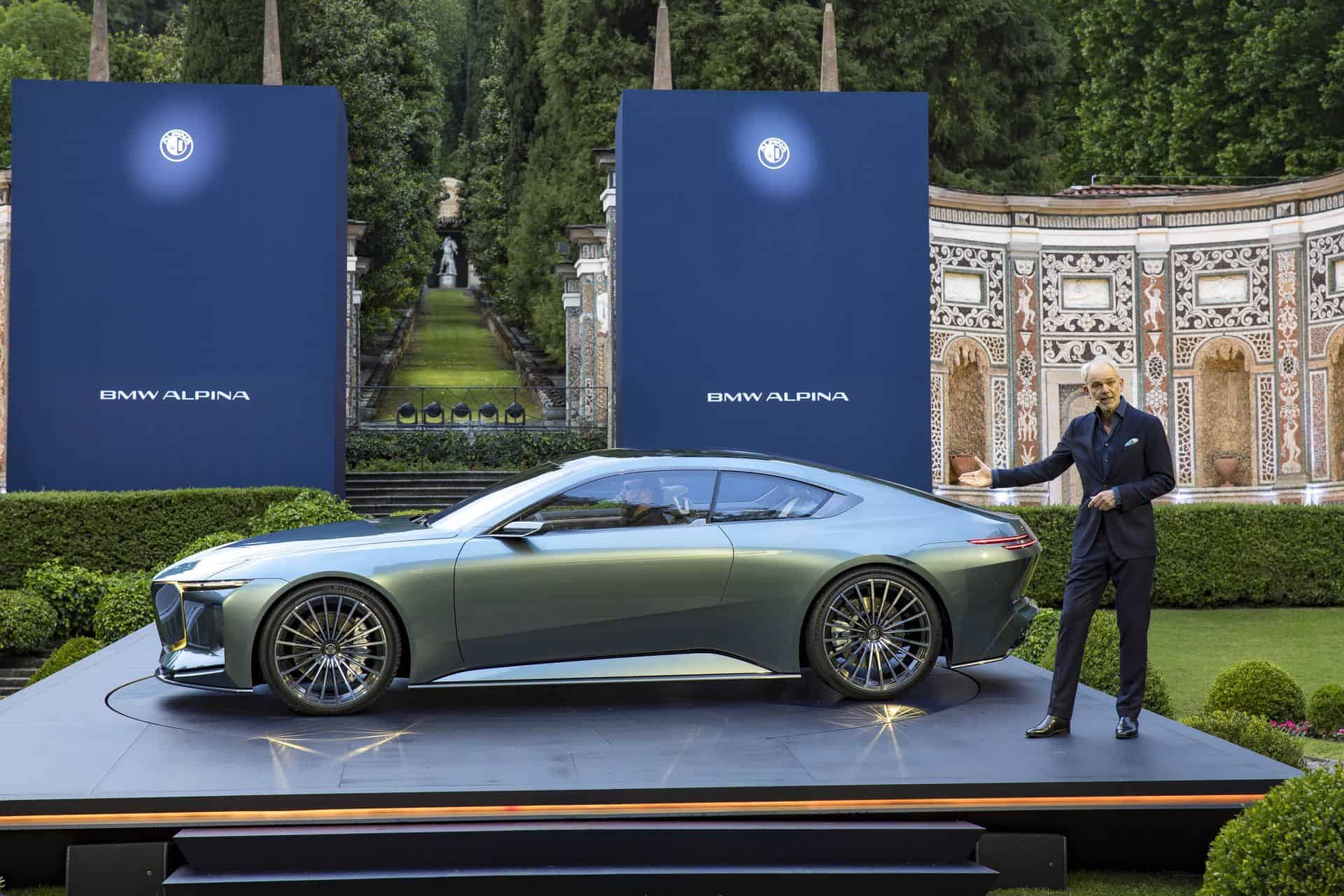
At the 2026 Concorso d’Eleganza Villa d’Este last week, BMW pulled the wraps off its ALPINA Vision Car — a long, low grand tourer built on a G16 8 Series Gran Coupe platform, showing a design language that isn’t on any current BMW, and raises more questions than it answers about where this brand is actually headed. We sat with van Hooydonk in a small group session on the shores of Lake Como after the car’s debut and asked most of them.
The Most Significant Concept Of His Career

When someone asked whether this was the most important concept van Hooydonk had presented at Villa d’Este, he didn’t hedge.
“I would say that yes, because we have not many brands — we have Mini, Rolls-Royce, BMW Motorrad, and BMW. I’ve been with the company for quite a while. I wasn’t there when BMW was founded, to be honest, but I was there when we acquired Mini and Rolls-Royce, so I know how BMW goes about bringing a new brand into the fold.”
The process, as he describes it, is the same every time: study the history hard, identify what matters, keep it, and build from there. What makes this moment different from prior Villa d’Este concepts is that BMW can no longer claim these are just design exercises. They’ve been showing concept cars here for over a decade, and some of them — Skytop, Speedtop — became production cars.
Where The Design Actually Came From

The sharknose front is the first thing that hits you. One journalist compared it to a “David Cameron-esque” sharpness — the kind of acute, almost aggressive point that disappeared from German grand tourers sometime around the mid-2000s. Van Hooydonk said the direct reference is the ALPINA B7 Turbo Coupe, the E24 6 Series with the extreme nose and deep plan view.
“This one takes it even further,” he said. “It’s even more acute, even more extreme, more sculptural, more three-dimensional.”
The rear was harder. BMW’s recent cars have gone either vertical or rearward-leaning at the top. Neither felt right for ALPINA. The solution came from the same source car: the E24 6 Series also has a slanted rear at this angle. That historical precedent gave the team permission to go there, and then they mirrored the plan shape front-to-back to give the car visual coherence.
The Quiet Luxury Position

When asked how much the new ALPINA production cars would visually differ from the BMW donor car underneath them, van Hooydonk was honest about the answer: not much, and on purpose.
“An ALPINA is for connoisseurs, meaning people that love driving, they like driving fast, but they don’t want to communicate to the outside world that they bought a race car. That would be an M customer. And therefore we thought that is the position, that is the opportunity for ALPINA.”
He contrasted this directly with where M has gone — louder, brighter colors, more visible aero. ALPINA is going the other way. If a customer wants zero exterior distinction and just a tasteful color, that’s fully available.

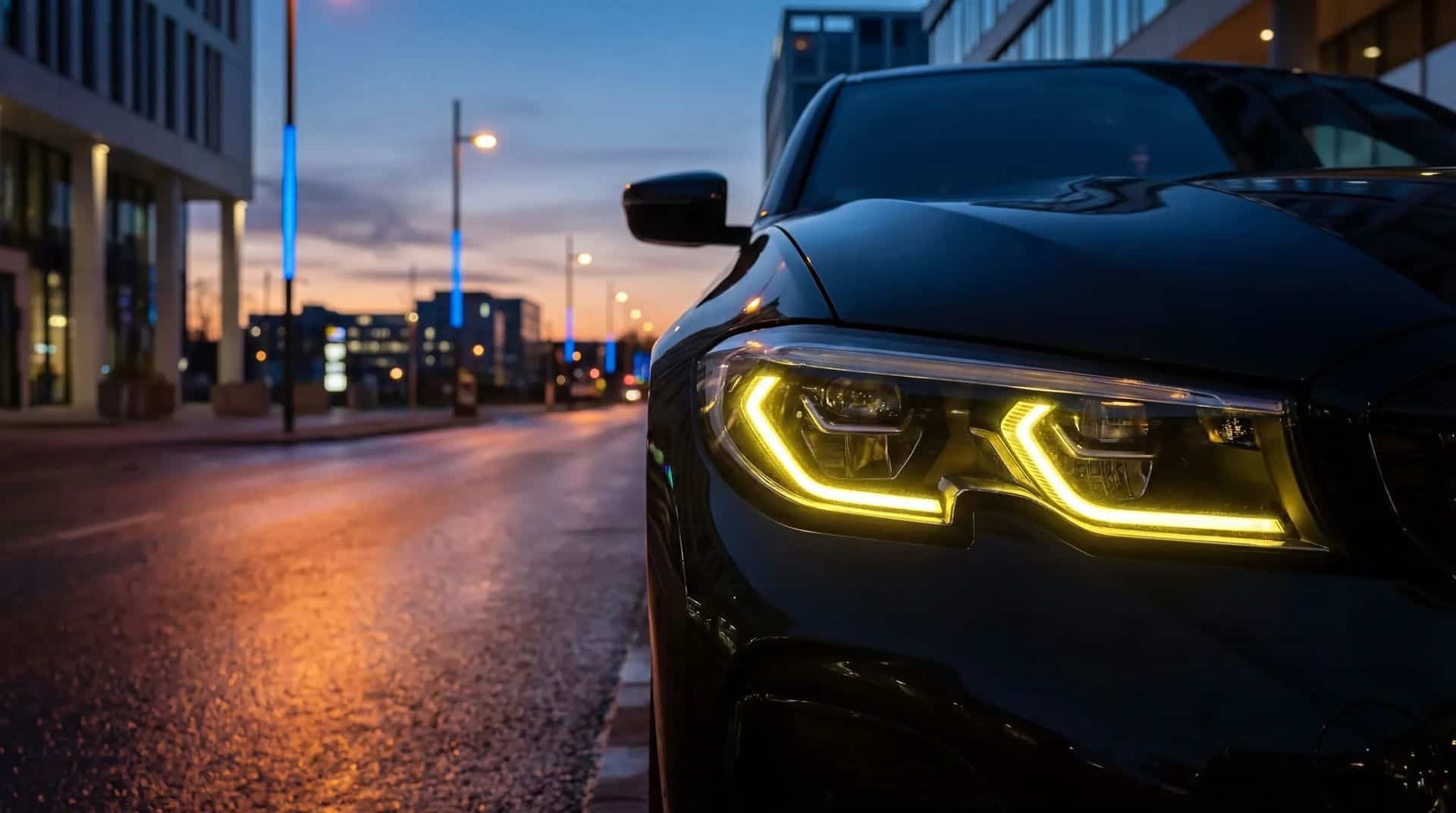
But for those who do want the signals, they’re defined and on display in the concept: the “ALPINA” wordmark in the lower air dam, amber daytime running lights that are always present and not optional, 20-spoke wheels with spokes extended all the way to the rim edge rather than set inward as the old ALPINA wheels were, oval exhaust tips, and body-side striping that is now painted rather than applied as a sticker.
The wheel design change drew a direct question — would there still be a traditional ALPINA wheel with the deeper barrel? The answer was no. “We prefer to actually make the wheel look even bigger by extending the spoke all the way to the outside of the rim. I know ALPINA had them always set in, but that doesn’t look as big, and now with different production methods we can extend the length of the spoke. And 22 inches, 23 inches — also not so bad.”
What The Bovensiepen Relationship Actually Looked Like

One of the more interesting threads in the conversation was about what ALPINA’s relationship with BMW looked like before the 2022 acquisition — and why the merger was, in van Hooydonk’s telling, natural for both sides.
“Every time we designed a new BMW, Mr. Bovensiepen Senior, when he was still alive, would come in, look at the car, and then he would go back and think about what he could do to it. But there was always this strive for good coexistence, because he was very smart in the sense that he always looked at BMW’s product portfolio including M and decided always to make an offer that M or BMW didn’t already have.”
The Z8 example is the one he chose: BMW offered the Z8 as a manual only. Bovensiepen offered it as an automatic, which was almost the philosophical opposite of what BMW was doing at the time. The old ALPINA was built on finding what fell through the cracks.
The reason the family eventually sold is, per van Hooydonk, straightforward: modern cars have become too electronically complex to tune the way ALPINA was built to tune them. Changing a camshaft and carburetor is one thing. Software-controlled suspension and drivetrain systems require OEM resources. “Their business was founded on tuning engines in the times that you could do a different camshaft and different carburetors,” he said. “So it was for them, I think, also a natural way of things to have this merge.”
Based On The 8 Series Gran Coupe

The vision car sits on a G16 8 Series Gran Coupe platform. That’s why it has the wheelbase it does and why it seats four properly. Someone asked whether it was 7 Series — it’s not — and then the obvious follow-up landed: the 8 Series has been discontinued, so what does the production version sit on? “We don’t know,” van Hooydonk said. “The 8 Series has run out. If we were to do it, we have to start from scratch and think hard.”
The first production ALPINAs will be 7 Series-based and arrive next year. But the longer play — which van Hooydonk acknowledged and didn’t close the door on — is whether ALPINA ever gets a platform of its own, not derived from a current BMW product. The vision car was deliberately built on something that doesn’t exist in showrooms precisely to make that point. “We want to set the brand on its own course within the BMW Group,” he said, “like M, of course, is closely affiliated to BMW — but you know how much freedom they get inside our company.”
No Internal Resistance
One journalist pressed on whether there was resistance inside BMW to letting ALPINA stray too far from the BMW DNA. The answer was a flat no. “BMW thought long and hard about acquiring ALPINA. We don’t buy brands every day. ALPINA was always based on BMWs, first just as tuning kits, then as a company with manufacturer status and their own chassis numbers. Everybody is convinced that’s how you have to treat it. You have to give it a certain autonomy to prosper.”
The comparison to M isn’t incidental — it’s the operating model. M has a dedicated design team, its own suspension and drivetrain philosophy, and genuine internal independence. Van Hooydonk said ALPINA now has the same: its own dedicated design team working in parallel, not as a sub-department of BMW design.
V8, 300 km/h

When someone pointed out that one thing the static concept couldn’t convey was the exhaust note — ALPINAs have always sounded different from BMWs — van Hooydonk confirmed the car at the event is running a V8, and that V8s will be part of the ALPINA lineup. “The cars will be fast. ALPINAs have always been faster than BMWs. We’re thinking 300 kilometers an hour, something like that. But you won’t see it so much.”
The suspension is tuned for both speed and long-distance comfort. The profile being described is a genuine grand tourer — travel fast, travel far, arrive not exhausted. The engineers are still working on the exhaust character specifically. Van Hooydonk joked, mildly, that if he were better with numbers he’d have taken a different career path. The horsepower figures aren’t being released yet, but it’s not hard to figure out what the S68 4.4 liter TwinTurbo can do.
Starting At The Top, Expanding Carefully

Existing ALPINA loyalists who want a B3 or B5 equivalent will wait. BMW is starting the new chapter at the top of the range and moving down slowly, deliberately — and Van Hooydonk was direct about why. “When you try to do a new chapter on an existing brand, you can’t turn 10 pages at once. You have to take one by one. We’re not going to flood the market with ALPINA offerings in all sizes and all segments.”
The stated goal is natural demand: produce slightly fewer cars than the market wants, let scarcity do the positioning work, and build the customer base from the top down. The first priority was making sure existing customers weren’t alienated — BMW has been running private dinners where they showed individual elements (a wheel, a color swatch, the new logo) without a car present, specifically to gauge and manage the reaction before anything went public.
That concierge relationship is staying. BMW is also redesigning the retail environments — dedicated spaces inside dealerships where ALPINA customers can sit with materials, feel the upholstery options, and configure their car in person. Whether there will be a named bespoke program analogous to Mulliner at Bentley or BMW’s own Individual designation is still undecided. The Comfort Plus drive mode, one of the old ALPINA exclusives, will remain ALPINA-exclusive.
Traditional ALPINA green and blue are staying in development. If someone wants a period-correct color, they can have it exactly. New curated combinations will also be available for customers who want something that reads as Alpina but not necessarily vintage ALPINA. BMW is likely to release more information about the future of the ALPINA brand in the near future, especially as we get close to the first units rolling down the street.