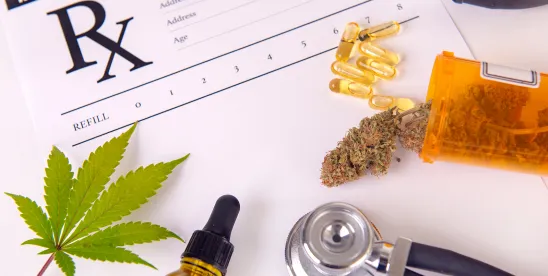
Dr. Marty Makary resigned as FDA commissioner last week, barely a year after his Senate confirmation. HHS Secretary Robert F. Kennedy Jr. confirmed the departure and indicated the agency is searching for a replacement. Kyle Diamantas, FDA’s deputy commissioner for Food, will serve as acting commissioner in the meantime. The vacancy arrives at an extraordinarily consequential moment: a rescheduling proceeding on adult-use marijuana is scheduled to begin June 29; an executive order directing FDA to fast-track psychedelic drug reviews is sitting on the agency’s desk; the regulatory framework for what federal Schedule III status actually means for medical marijuana is very much a work in process; and a November 2026 deadline is fast approaching that could upend the hemp and CBD market as it currently exists. The person who fills this seat will have more influence over the direction of cannabis and psychedelics law than any FDA commissioner in history. And right now, that seat is empty.
Who Is Being Considered
A handful of names have surfaced as potential nominees. Former FDA Commissioner Dr. Stephen Hahn, who served from 2019 to 2021, is reportedly under consideration, as is Dr. Brett Giroir, the former assistant secretary for Health who served as acting commissioner ahead of Hahn’s confirmation. Also being discussed are Grace Graham, FDA’s current deputy commissioner for Policy, Legislation and International Affairs, and Sara Brenner, recently appointed as senior counselor for Public Health to Kennedy. Any nominee will require Senate confirmation.
Why the FDA Commissioner Matters for Cannabis
The FDA commissioner sits at the center of every major federal policy decision affecting drugs under the Controlled Substances Act, and that includes cannabis. The April 2026 rescheduling order moved state-licensed medical marijuana and FDA-approved medications to Schedule III — an action that originated in an HHS scientific and medical evaluation and that the FDA played a central role in developing. The downstream regulatory work that rescheduling triggers is, in significant part, FDA’s work to do.
Among the most consequential open questions: How will FDA treat cannabis products under the Federal Food, Drug, and Cosmetic Act? The rescheduling order did not resolve whether THC-containing products can be marketed as foods or dietary supplements, whether they require new drug applications, or how labeling and safety standards will develop for the state-licensed industry. The order reclassified a scheduling category; it did not build the regulatory framework that a fully integrated federal-state cannabis system will eventually require. That framework will be shaped, in substantial part, by the commissioner’s priorities and the agency’s enforcement posture.
The April order also addressed only state-licensed medical marijuana and FDA-approved medications. Botanical cannabis more broadly — including adult-use products — remains Schedule I pending a separate administrative hearing process scheduled to begin June 29, 2026. How FDA engages in that proceeding, and whether the agency supports or opposes further rescheduling, will reflect the commissioner’s views. Supporters of broader rescheduling argue it would bring more of the existing cannabis market under federal oversight and provide regulatory clarity; critics contend it would normalize recreational use before the public health consequences are adequately understood. The next commissioner will inherit that debate and will have a meaningful voice in how it resolves.
Why the FDA Commissioner Matters for Hemp and CBD
If the marijuana and psychedelics questions were not enough, the new commissioner will also inherit one of the most tangled and time-sensitive regulatory problems in the agency’s portfolio: what to do about hemp-derived CBD and the looming November 2026 deadline that threatens to destabilize the hemp market entirely.
The short version of a long and complicated history: The 2018 Farm Bill legalized hemp and preserved FDA’s authority to regulate hemp-derived products under the Federal Food, Drug, and Cosmetic Act. FDA promptly concluded that CBD — the hemp-derived cannabinoid that had become a multibillion-dollar consumer market — could not lawfully be sold as a food ingredient or dietary supplement. The reason was the FD&C Act’s drug preclusion provision: Because CBD had been approved as a prescription drug (Epidiolex) before it was marketed as a food ingredient, it was excluded from the dietary supplement pathway by statute. FDA acknowledged the problem, concluded in January 2023 that a new regulatory pathway was needed, said it would work with Congress to develop one, and then — in the nearly three years since — did not issue one.
Congress, growing impatient, acted in November 2025. As part of the Continuing Appropriations Act, it narrowed the definition of lawful hemp to exclude any product with more than 0.4 milligrams of combined THC per container and any cannabinoids that are synthesized or manufactured outside the Cannabis sativa L. plant. That provision takes effect November 12, 2026 — a deadline that, if it arrives without additional regulatory clarity, will render a wide swath of currently marketed hemp-derived products unlawful overnight. The hemp industry has been lobbying hard for an extension through the Hemp Planting Predictability Act, and a separate bipartisan bill — the Hemp Enforcement, Modernization, and Protection (HEMP) Act — would direct FDA to establish CBD milligram limits through formal rulemaking, with automatic statutory limits taking effect if the agency fails to act within three years.
Into this environment, Makary made one notable move before his resignation. In April 2026, he issued a letter indicating that FDA would exercise enforcement discretion with respect to orally administered, hemp-derived CBD products provided to Medicare beneficiaries under physician direction — a narrow but meaningful acknowledgment that the existing framework was not working and that some degree of access for patients was appropriate even in the absence of a formal regulatory pathway. It was a signal, not a solution. The full solution — a durable regulatory framework that addresses product safety standards, labeling requirements, THC content limits, and the relationship between the hemp-derived CBD market and the prescription drug pathway — remains unbuilt.
The new commissioner will face two immediate hemp and CBD decisions. First, whether to support or resist an extension of the November 2026 deadline — a question that implicates hundreds of thousands of farmers, manufacturers, and retailers whose livelihoods depend on knowing whether their products will be lawful past this fall. Second, and more fundamentally, whether to finally develop the comprehensive regulatory framework for hemp-derived cannabinoids that FDA has been promising since 2023. President Trump’s December 2025 executive order on medical marijuana and CBD research explicitly directed FDA, HHS, CMS, and NIH to develop a unified federal approach to hemp-derived cannabinoid products, including guidance on THC per serving limits, per container limits, and CBD to THC ratios. That directive has been sitting, largely unimplemented, for five months. Whether it moves forward — and how — is now a question for whoever succeeds Makary.
Why the FDA Commissioner Matters for Psychedelics
Trump issued an executive order in April 2026 directing FDA to prioritize review of psychedelic compounds for medical use, with a particular focus on psilocybin, MDMA, and ibogaine as potential treatments for conditions including PTSD, depression, and addiction. That directive created an institutional mandate, but mandates require leadership to execute. The pace, rigor, and outcome of expedited psychedelic reviews will depend heavily on how the new commissioner interprets and implements the president’s directive.
FDA’s track record with psychedelic drug applications has been mixed. The agency granted breakthrough therapy designation to psilocybin for treatment-resistant depression and to MDMA for PTSD, but subsequently declined to approve MDMA-assisted therapy based on concerns about trial design and data integrity. The agency’s scientific and evidentiary standards have not been publicly revised, and the question of whether an expedited review process will involve different standards — or simply a faster application of existing ones — remains open. Where the new commissioner lands on that question has significant implications for the psychedelic therapy industry and for the patients and physicians who have been following the Right to Try and compassionate use arguments we have covered on this blog.
Opinions within the medical and scientific community on psychedelic drug approval vary considerably. Proponents argue that the existing evidence base is strong enough to support approval for specific conditions and populations, and that FDA’s existing standards can accommodate approval. Critics, including some within FDA’s own scientific staff, have raised questions about trial methodology, the challenges of blinding in psychedelic studies, and long-term safety data. The commissioner will need to navigate those competing views and establish a coherent standard that the agency can apply consistently.
The Confirmation Process and What to Watch
Given the FDA’s central role in both cannabis rescheduling proceedings and psychedelic drug review, the confirmation hearing for the next commissioner nominee is likely to include pointed questions about both topics. Senators on both sides of those debates will want to understand where the nominee stands. For practitioners and operators tracking these areas, the nominee’s public statements, prior positions, and confirmation testimony will be the most direct available signal about the agency’s direction under new leadership.
We will be watching the nomination and confirmation process closely and will provide updates here as they develop. In the meantime, the acting commissioner and the career FDA staff who have been managing these proceedings will continue the agency’s work. Major regulatory actions — including FDA’s participation in the June 29 broader rescheduling hearing and any decision on the November 2026 hemp deadline — are unlikely to wait for a permanent commissioner to be confirmed.
Conclusion
There is a version of the next FDA commissioner who accelerates the regulatory framework for Schedule III medical marijuana, engages constructively in the June 29 rescheduling hearing on adult-use marijuana, implements the psychedelics executive order with rigor and scientific integrity, and finally builds the durable hemp and CBD framework that FDA has been promising since 2023. There is also a version who treats all of these matters as secondary to the agency’s more traditional portfolio of food safety, pharmaceutical approvals, and device regulation — and who presides over a November 2026 hemp deadline that arrives without a solution. And there are many points in between.