Over the past few years, the Federal Trade Commission’s (FTC) Care Labeling Rule1 has created new challenges for global apparel manufacturers operating in the modern digital-first world. Issued in 1971, the FTC intended the Care Labeling Rule to ensure consistent and clear written instructions for the regular care of textile wearing apparel. The Care Labeling Rule, with its rigid standards, however, is showing its age over 50 years later. As a result, the industry has been forced to navigate the friction between differing standards for care labeling across borders and weigh the risks of potential noncompliance with the benefits of modernization.
What Does the FTC Care Labeling Rule Require?
The FTC’s Care Labeling Rule requires that textile wearing apparel2 labels state the regular care needed for ordinary use of the product, including washing, drying, ironing, bleaching, and warning instructions on a printed, permanent “care label” affixed to the product.3 This care information may be indicated by “[a]ny appropriate terms . . . so long as they clearly and accurately describe regular care procedures and otherwise fulfill the requirements of this regulation,”4 including, but not limited to, specified terms identified by regulation.5
Care labels may also include “[a]ny appropriate symbols . . . in addition to the required appropriate terms so long as the terms fulfill the requirements of this part.”6 Many apparel companies develop proprietary care icons or adopt international sets, such as International Organization for Standardization (ISO)-based symbols, to provide clear, easy-to-read visual instructions. Under the Rule, however, these additional icons must be supplemented with corresponding written terminology—creating redundancy on labels— regardless of their clarity or practical utility. Self-created or internationally recognized symbols are not accepted as a substitute for text.
As an alternative to written care instructions, the Care Labeling Rule, as amended in 1997, does permit manufacturers and importers to permanently affix certain symbols from ASTM D5489-96c to care labels as a means of describing apparel care requirements without additional text.7 Thus, while the Rule permits companies to use symbols without terms, this is only allowed if the symbols are those identified in ASTM D5489-96c:
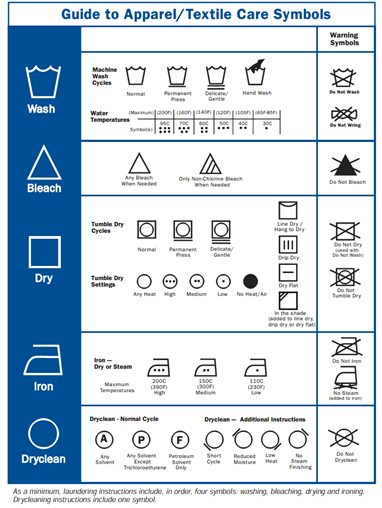
The FTC considers noncompliance with these requirements, including the failure to permanently affix a care label with printed care instructions to textile wearing apparel, unfair or deceptive acts or practices subject to civil penalties and other enforcement mechanisms.8
The Care Labeling Rule Creates Challenges for Global Companies
The Care Labeling Rule’s strict requirements for written care terminology and/or the use of symbols from ASTM D5489-96c, but no allowance for the use of other internationally recognized or company-created symbols, create unexpected problems for global companies that are also balancing international requirements, including the European Union (EU) General Product Safety Regulation (GPSR).
While the FTC framework focuses primarily on clarity and truthfulness of care instructions, the EU’s GPSR mandates that instructions be provided “in a language which can be easily understood by consumers, as determined by the Member State in which the product is made available on the market.”9 This has been interpreted to mean that written instructions must be provided in the official language(s) of the member states where the product is marketed and/or sold. In practice, this means apparel labels balloon in size with multiple translations to comply across twenty-seven EU member states or companies create separate labels for different regions, increasing potential logistics headaches and costs. If a company fails to comply, it risks fines, sales bans, or the implementation of other enforcement tools from impacted member states. This duplication burden and the risk of enforcement actions and other costs could be avoided, however, if information and instructions were moved to a QR code or online resource, accessible in multiple languages.
Bridging Apparel Labeling Requirements in a Digital-First World
The FTC has made few changes to the Care Labeling Rule since its creation in 1971, one being the permitted use of certain symbols from ASTM D5489-96c in lieu of care labeling terminology in 1997. Unfortunately, other efforts to modernize the Rule over the past several years have largely been unsuccessful, including: 1) a 2012 proposal that was never implemented, which included, among other things, an update to allow the use of ISO 3758:2005(E) symbols in addition to the approved ASTM symbols; and 2) a contemplated full repeal of the Rule in 2020/2021.10 Most recently, in late February 2025, the American Apparel and Footwear Association (AAFA) submitted a petition to the FTC to digitize care labels.11 The FTC opened public comment on the petition and received many responses until the comment period closed on April 18, 2025.12
As of 2023, 60% of shoppers globally see value in the ability to scan a QR code for detailed garment care instructions.13 From the commentary to the AAFA petition, it seems that many in the industry feel the same.14 As companies seek to streamline labels, reduce clutter, and adopt more flexible digital communication methods, global regulatory misalignment adds complexity, cost, and inefficiency to the process. As the AAFA noted in its FTC petition, allowing the use of URLs or QR codes could also make it easier for global companies to meet EU Digital Product Passport supply chain and sustainability requirements.15
Increasingly, companies are taking a global sales approach, meaning they must comply with several often-conflicting regulatory schemes. But the practical result is a lengthy, itchy, and confusing label. For example, apparel sold in both the U.S. and EU must comply with the FTC Care Labeling Rule requirements and the GPSR requirements, meaning the garments must include both ASTM-approved symbols or written terms (or text in English if non-ASTM symbols are used) and text in each official language of the EU states of sale. Modernizing the Care Labeling Rule could lessen some of these difficulties.
Replacing these problematic labels with QR codes or digital links could convey extended care information, enable reduced textile waste in label production,16 result in space-saving designs that avoids clutter, and allow companies to update information in real time without reprinting labels. Given the Care Labeling Rule predates the internet and thus does not recognize digital delivery as a substitute for required on-label text or ASTM symbols, the Rule’s static approach creates a compliance barrier for companies seeking hybrid labeling models — where basic care instructions might be provided via internationally recognized symbols on the label with detailed instructions (and translations) accessible through a QR code.
As a result, though QR code use in the apparel industry is increasing, QR codes and digital content remain underutilized.
Recommendations for Simplification and Modernization
The FTC’s Care Labeling Rule has served consumers well in ensuring clarity and accuracy for garment care instructions. However, it has not aged well, and its inflexibility with respect to the use of symbols, language, and digital tools has created compliance inefficiencies and confusion, especially in the context of global trade. Companies and consumers alike would benefit from the use of QR codes and links to convey information, harmonizing compliance while also improving the consumer experience. The following policy updates could help simplify labels and bring everyone into the modern age:
- Acceptance of international care symbols. Allow equivalent non-ASTM symbol sets such as ISO standard icons to substitute for text instructions.
- Digital labeling flexibility. Recognize QR codes or digital resources as compliant carriers of instructions and care content.
- Harmonization with global language requirements. Explore cross-recognition with international laws and standards, including the EU GPSR’s multilingual mandate, to avoid duplication.
- Clear distinction between “essential” and “non-essential” care instructions. Update guidance to permit non-essential recommendations to appear without triggering written-text obligations.
References
- The Care Labeling of Textile Wearing Apparel & Certain Piece Goods Rule can be found at 16 C.F.R. Part 423.
- “Textile wearing apparel” is “any finished garment or article of clothing made from a textile product that is customarily used to cover or protect any part of the body, including hosiery, excluding footwear, gloves, hats or other articles used exclusively to cover or protect the head or hands.”16 C.F.R. § 423.1(g).
- 16 C.F.R. §§ 423.1(a), 423.3; see FTC, Care Labeling of Textile Wearing Apparel & Certain Piece Goods, https://www.ftc.gov/ legal-library/browse/rules/care-labeling-textile-wearing-apparel-certain-piece-goods-text#:~:text=In%20addition%2C%20 symbols%20from%20the,%2C%20N.W.%2C%20 Washington%2C%20DC.
- 16 C.F.R. § 423.2(a).
- 16 C.F.R. § 423.2(c); 16 C.F.R. Part 423, App’x A
- 16 C.F.R. § 423.2(b) (emphasis added).
- 16 C.F.R. § 423.8(g).
- 16 C.F.R. § 423.5.
- EU General Product Safety Regulation, Regulation (EU) 2023/988, https://eur-lex.europa.eu/legal-content/EN/TXT/ HTML/?uri=CELEX:32023R0988.
- FTC, FTC to Host Roundtable on Proposed Changes to its Care Labeling Rule for Clothing (Feb. 11, 2014), https://www.ftc.gov/ news-events/news/press-releases/2014/02/ftc-host-roundtable-proposed-changes-its-care-labeling-rule-clothing#:~:text=The%20Rule%2C%20officially%20called%20 the,labels%20providing%20a%20wetcleaning%20instruction; FTC, Statement of the Federal Trade Commission on the Proposed Repeal of the Care Labeling Rule (July 21, 2021), https://www.ftc.gov/legal-library/browse/cases-proceedings/ public-statements/statement-federal-trade-commission-proposed-repeal-care-labeling-rule.
- Petition for Rulemaking Concerning the Digital Labeling of Apparel (posted by the FTC on Mar. 19, 2025), https://www. regulations.gov/document/FTC-2025-0024-0002.
- Comment From Italian Footwear Manufacturers’ Association, Docket FTC-2025-0024-0011 (Apr. 7, 2025) (“The introduction, by law, of a digital system should be an important opportunity to align criteria and facilitate the task of exporting and importing companies in the sector. In the European Union we will soon have the Digital Product Passport. There are three requirements that drive this need: to simplify information flows between the production chain and the consumer, to make processes more sustainable by reducing the environmental impact generated by labelling materials, and to adopt common standards between economic partner areas.”); Comment from Consumer Technology Association, Docket FTC-2025-0024- 0015 (Apr. 11, 2025) (“In today’s digital era, consumers increasingly rely on electronic means to access product information. Digital labeling or e-labeling, utilizing tools such as QR codes or URLs, offers manufacturers a dynamic platform to convey comprehensive and up-to date information to consumers. This approach, which CTA has encouraged regulators to embrace across all product categories for more than a decade, not only enhances transparency but empowers consumers to make informed product purchasing decisions.”); Comment from American Association of Importers and Exporters, Docket FTC-2025-0024-0019 (Apr. 16, 2025) (AAEI “is writing to express our support for the petition (FTC-2025-0024) submitted by the American Apparel and Footwear Association (AAFA) requesting the modernization of the Care Labeling of Textile Wearing Apparel & Certain Piece Goods Rule to allow for digital labeling as an alternative to the current labels mandated As of 2023, 60% of shoppers globally see value in the ability to scan a QR code for detailed garment care instructions.29 From the commentary to the AAFA petition, it seems that many in the industry feel the same.30 As companies seek to streamline labels, reduce clutter, and adopt more flexible digital communication methods, global regulatory misalignment adds complexity, cost, and inefficiency to the process. As the AAFA noted in its FTC petition, allowing the use of URLs or QR codes could also make it easier for global companies to meet EU Digital Product Passport supply chain and sustainability requirements.31 by the Rule. As detailed in the petition, the current regulatory framework is outdated and does not align with today’s technological advancements or consumer expectations. . . . The current care labeling requirements have led to label creeping as small text in multiple languages with confusing symbols proliferating on large and uncomfortable tags. This is not only inconvenient for consumers and manufacturers, but wasteful. Allowing digital labels, such as a QR code or URL placed on a small tag, offers a sustainable alternative to the millions of miles of labeling tape produced annually and enables consumers to access care instructions and additional product information in a more convenient and accessible format.”); Comment from U.S. Fashion Industry Association, Docket FTC-2025-0024-0001 (Apr. 18, 2025) (“USFIA is in full agreement with the regulatory language proposed by AAFA. We emphasize that textiles and apparel is a global business. USFIA members market their products throughout the world. Different markets have different labeling requirements and different language requirements. This has led to ever larger and more complicated care labels. These extensive labels are wasteful and uncomfortable for consumers. Digital labels would effectively reduce trade barriers for global companies. Digital labeling would allow firms to provide detailed product information for multiple countries in a readily accessible manner, such as using a simple QR code or other digital tools, resulting in reduced labels and label size. This approach also would enable firms to provide updated information to consumers, something which is not realistically available under the current system. Finally, it is sometimes the case that over time labels become illegible. The likelihood of that happening with a digital label is diminished. Allowing the use of digital labels would establish a more harmonized approach to labeling as other countries, such as the EU, Singapore and Australia, have proposed or enacted digital labels.”).
- Avery Dennison, Digital Consumer Behavior Report 2.0 (2023), https://brand.averydennison.com/share/ Fi56GgtiKCqw6ajutmFY/assets/44198.
- See n. 11, supra; but see Comment from National Cotton Council of America, Docket FTC-2025-0024-0022 (Apr. 17, 2025) (“Relying on digital-only formats would leave some consumers without easy access to essential product information, which they use to determine clothing care and allergy information and to understand better what they are buying. While smartphone usage is high, 30% of adults over 65 and 43% of low-income consumers lack broadband access at home. Privacy concerns, digital fatigue, and technology limitations further discourage scanning QR codes.” (internal citations omitted)).
- Petition for Rulemaking Concerning the Digital Labeling of Apparel (posted by the FTC on Mar. 19, 2025), https://www. regulations.gov/document/FTC-2025-0024-0002.
- Comment from U.S. Chamber of Commerce, Docket FTC-2025- 0024-0001 (Apr. 15, 2025) (“Digital technologies offer an efficient and economical alternative to traditional care labels. By adopting digitized care labels such as QR codes, the U.S. can reduce labeling waste and aid decarbonization efforts, potentially eliminating at least 343,000 metric tons of CO2e from supply chains.”).