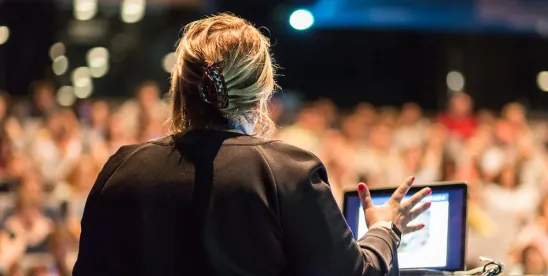
Some of America’s most wealthy women have been leading the way in philanthropy of late, while bringing a growing visibility to the power of giving. In a couple of notable instances, women emerging from divorces to tech titans have used unprecedented giving to reintroduce themselves to the public and emerge from the shadows of their ex-husbands.
In fact, it even appears that art is now imitating life, as seen in the Apple TV+ series Loot. In the pilot episode of Loot, we see billionaire wife Molly Novak receive lavish gifts from her husband that leave her unsatisfied. She realizes she misses the early days of their partnership, when they devoted their time to building a business together.
Soon after this realization, Molly learns that her husband is cheating, and she announces she will be getting a divorce. They did not have a prenuptial agreement, and Molly received an $87 billion divorce settlement. It takes time for her to find her footing, but the newly minted Molly Wells learns that philanthropy provides her a purpose in life.
Molly Wells represents a satirized version of a wealthy, divorced woman’s evolution to philanthropy. However, we see some truths about women staking a place in public life through their giving. Philanthropy at this level provides an opportunity to lead where there might not otherwise be a chance. Women with wealth obviously have access to resources that can create change, and taking that role public will often increase the impact.
In the coming years, it is estimated that “$84.4 trillion in assets will be passed down from the Silent Generation and baby boomers to their loved ones” in what is being termed the “Great Wealth Transfer.” In the near future, women will have access to wealth on a scale we have not seen before. Let’s examine some of the reasons a wealthy woman might decide to enter the public world by making philanthropic gifts.
Becoming Active in Philanthropy Creates Leadership Roles
Melinda French Gates is one of the most well-known modern female philanthropists. She purposefully kept her life private while her children were young. Later, Melinda undertook a public role overseeing the Gates Foundation in 2007, while her husband served as the Chairman of Microsoft. Until this point, despite her work, her husband’s role meant he received the public’s attention.
French Gates took the spotlight for the first time at the 2007 World Economic Forum to discuss “health, development and women’s issues before a VIP audience.” It was important to French Gates that the public understand the Gates Foundation was a joint effort between her and Bill Gates. She wanted her daughters (and other girls presumably) to know they are powerful too. The type of leadership exercised by French Gates is not unusual in public service foundations, considering that over 60% of foundation CEOs are women.
Entering the Public Space Provides a Platform to Influence Social Causes
Following her divorce from Jeff Bezos, Mackenzie Scott pledged to give away the majority of her wealth. Her foundation, Yield Giving, donated $7.16 billion in 2025 to organizations across the globe. In total, Scott has given away $26.3 billion since her 2019 divorce. Scott’s approach has been transformative not only in the scale and speed of her giving, but in how she has challenged traditional ways of giving. She is choosing a “purposeful philanthropy” that moves money into communities with fewer strings and much more trust.
From her writings, we can glean that Scott views commitment to charity as a thoughtful obligation. She is aware of the people who helped her when she struggled and how even small acts can have a positive influence. Scott has not been as outspoken as French Gates about the targets of her giving, but she has given freely to causes focusing on education, the environment, and social justice. The scale of her giving, and her earnest commitment to it, all but ensure it makes an impact.
Being a Public Image of Philanthropy Can Shape Public Policy
An interviewer asked French Gates what she had learned about improving gender equality. Her response echoes a third reason women enter the public world through philanthropy: to change public policy. French Gates responded,
What I learned through 25 years of philanthropy at the Gates Foundation . . . is that when women have their full power—their voice, their decision-making capabilities, their own resources—they are better off, their families are better off and society is healthier. And I have seen it time and time and time again . . . So, I am determined that we need to get women further in society.
Today, French Gates leads Pivotal, a group of organizations she founded in 2015 to “accelerate the pace of progress for women and young people in the U.S. and around the world.”
Conclusion
Women with wealth are driven to take a public role in their giving for a variety of reasons. Philanthropy allows a woman to have a leadership role in situations where the spotlight might not otherwise shine on her. French Gates embraced a public role in her philanthropy so that the world would know she worked in partnership with her husband. As a result of this public role, she gained credibility in her post-divorce philanthropic efforts. Speaking publicly about a cause, or about philanthropy in general, also creates a large impact. Scott is leading a new direction for philanthropy in the years since her divorce that has been equally impactful, if not always as visible.
Especially for the ultra-wealthy, philanthropy isn’t a happy accident but an essential and fulfilling role—whether as part of a marriage partnership, or in the aftermath of divorce. Both French Gates and Scott received their wealth from divorce agreements, thereby acknowledging their independent legacies. But a woman with philanthropic goals should not wait until divorce to make her goals of giving a reality. Such goals can be incorporated easily into a prenuptial agreement to spell out how much is spent on donations, how often, and for which causes. With so much on the line, philanthropic interests must be planned, just like any other goal or asset a woman wishes to protect in a negotiation.