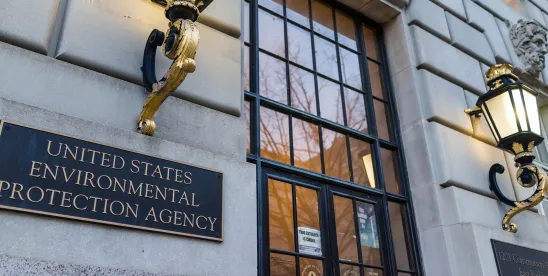
What Happened:On April 2, the U.S. Environmental Protection Agency (EPA) published the draft Sixth Contaminant Candidate List (CCL 6) pursuant to its authority under the Safe Drinking Water Act (SDWA), which directs EPA to designate potential contaminants for further study in contemplation of potential future regulation.
Who May Be Impacted: Public water systems subject to SDWA regulation, along with companies that manufacture or use any of the following: pharmaceuticals, certain PFAS, or microplastics.
Recommended Actions: Affected entities should carefully review the proposed CCL 6 and consider submitting written comments to EPA before the close of the comment period on June 1, 2026.
Background
The SDWA directs EPA to publish a CCL every five years, identifying unregulated contaminants for further study and potential future regulation. To be eligible for the CCL, a proposed contaminant must be known or anticipated to occur in public water systems but not currently subject to any national primary drinking water regulations.
On April 2, EPA published CCL 6, and EPA is expected to sign it for publication by November 17, 2026.
The CCL itself does not impose regulations, but listed contaminants become the subject of scientific study as potential candidates for future SDWA regulation as drinking water standards. CCL contaminants may receive a formal decision in the form of EPA’s “regulatory determination,” which determines whether EPA will regulate the contaminant under the SDWA. In each CCL cycle, EPA must make formal positive or negative declarations with respect to at least five contaminants from the CCL. When making regulatory determinations, EPA considers:
- Whether the contaminant may adversely affect human health;
- Whether the contaminant is known to occur or is substantially likely to occur in public water systems with a frequency and at levels of public health concern; and
- Whether regulation presents a meaningful opportunity to reduce health risks for people served by public water systems.
The proposed CCL 6 lists 75 individual chemicals plus 9 microbes, and importantly, also lists four broad contaminant groups—pharmaceuticals, microplastics, PFAS, and disinfection byproducts—for additional study.
1. Pharmaceuticals
Draft CCL 6 proposes to regulate pharmaceuticals as a “priority contaminant group.” CCL 3 and CCL 4 both included individual pharmaceutical substances, but CCL 6 marks the first time that EPA has taken a categorical approach to pharmaceuticals. Draft CCL 6’s proposed definition of “pharmaceuticals” is notably broad, adopting the Food and Drug Administration’s definition of “drug” under the Federal Food, Drug, and Cosmetic Act.
The inclusion of pharmaceuticals dovetails with EPA’s recent announcement of human health benchmarks for pharmaceutical levels in water.
2. Microplastics
Draft CCL 6’s other “priority contaminant group” is microplastics, based on a public nomination. This is the first time EPA has included microplastics on the CCL.
Draft CCL 6 does not define microplastics and highlights at least four major data gaps, including a health-based definition of microplastics, that require further research. To craft this definition, EPA explicitly calls for data on what type of microplastics are most associated with adverse health effects in humans via drinking water. EPA’s current preference appears to be a definition based on microplastic qualities such as color, polymer, shape, and size. EPA also appears concerned with filling data gaps regarding microplastic detection methods, mixtures, and sourcing.
3. PFAS
Draft CCL 6 includes PFAS as a chemical group. PFAS in CCL 6 would be defined the same way as CCL 5, including chemicals that contain at least one of three specified structures. The definition excludes PFAS that will already be regulated in drinking water by final publication of CCL 6. Therefore, this would exclude PFOS and PFOA, which were regulated in drinking water in 2024, following a CCL 4 regulatory determination.
4. Disinfectant Byproducts
Lastly, EPA proposed to include disinfectant byproducts (DBPs) as a chemical group in CCL 6. DBPs form when disinfectants used for antimicrobial treatment in drinking water react with materials in water. The group includes 27 DBPs, most of which were listed under CCL 5 but did not advance to regulation. The newly listed DBPs were identified through EPA consultation with microbial and DBP experts.
Next Steps
The SDWA sets a relatively low bar for inclusion on a CCL, and inclusion on the CCL is only the first step in a traditionally long process toward final regulation. As a result of final regulatory action, or even if EPA decides not to regulate a substance under the SDWA, inclusion of contaminants in CCL 6 could result in collateral impacts on manufacturers and users of listed contaminants. For example, presence on the CCL may lead to the development of robust occurrence and toxicological data that could give rise to challenges elsewhere, including NPDES and indirect discharge permit writing; tort litigation; and reputational risk.
Companies, utilities, and water purveyors should carefully review the proposed CCL 6. Affected entities should also consider submitting comments to EPA by the June 1, 2026, deadline. EPA’s decision to include or exclude a contaminant from a CCL itself is not subject to judicial review, so the goal of the comment period will not be an administrative record capable of supporting judicial review. Instead, this is an opportunity for the regulated community to help frame EPA’s concerns and guide EPA to efficient data-gathering for the regulatory determination process.