Article Summary
- BMW rebuilt a third of its Munich factory — including a brand-new body shop with 800 robots running at 98% automation — while continuing to produce up to 1,000 cars a day throughout the construction.
- The plant goes fully electric by 2027, and BMW says per-vehicle production costs will drop another 10% with the launch of the new BMW i3 this August, below the level of its current gas-powered models.
- The old engine manufacturing hall now assembles electric cars — and while a BMW i3 is still on the line, it’s already transmitting the status of up to 20,000 features in real time to the production system.
BMW has spent several years gutting and rebuilding roughly a third of one of its oldest factories while keeping up to 1,000 vehicles a day rolling off the line. The plant has been running for over a century. By 2027, it will make nothing but electric vehicles. Today, they are ready to show us behind the scenes.
A factory rebuilt from within
BMW is putting around €650 million into the Munich plant’s conversion. The new body shop was designed entirely through a virtual twin — a digital simulation used to plan every robot and workflow before anything was built in the real world. Eight hundred robots now handle the joining processes at about 98 percent automation. BMW also cut the number of joining process types down to five, a simplification that pays off across a lot of downstream coordination. The building generates its own electricity from a rooftop solar system and meets the KfW 40 EE energy efficiency standard.
The press shop stamps steel and aluminum boards into components — tens of thousands daily. BMW has standardized press and tool specs across its global network, so tools can be physically moved between plants and employees can rotate between sites without retraining. Off-cuts get sorted and sent back to produce new coils.
The paint shop now uses AI cameras to catch surface defects during the running process, not afterward. Automated systems correct variations on the spot. Older setups would flag issues for separate remediation; this one doesn’t wait. Exhaust air is cleaned with an electrically powered eRTO system rather than the thermal alternatives that require more energy.
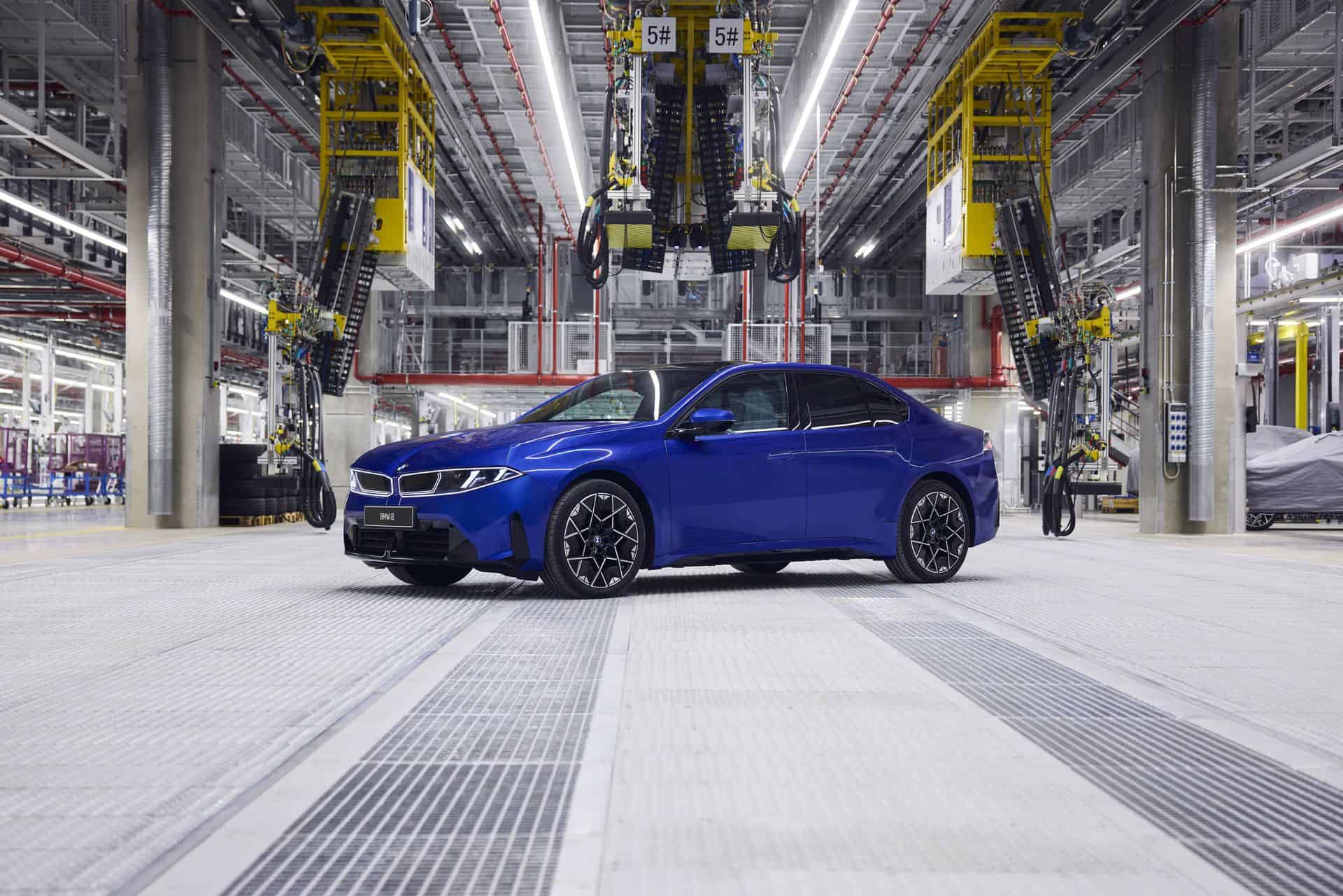
Assembly runs in what used to be the engine manufacturing hall. While a car is still on the line, the BMW i3 is already sending the status of up to 20,000 features to the production system — so problems surface immediately rather than at the end of the process.
2.5 million parts, every day

The logistics side is easy to underestimate. The plant moves about 2.5 million parts a day, and going forward, around 70 percent of those will go straight from delivery to the assembly workstation, no intermediate storage. That’s harder to pull off than it sounds, especially at a site wedged into a dense city neighborhood with no room to expand outward. BMW built a multi-story structure where parts arrive at street level and get distributed by conveyor to the right floor. About 60 percent of supply tasks will eventually be handled by automated robots and driverless vehicles, with a central digital control station managing the flow.
Munich also has something no other BMW plant has: it builds its own seats on-site. Every seat for every model made there is manufactured in-house and delivered to the assembly line in exact sequence. BMW uses the facility as its quality benchmark for seat production across the company, and tests new materials and manufacturing approaches there first.
The cost argument

Plant head Peter Weber says overall production costs will drop by another 10 percent once i3 production is running — below the level of the current vehicle generation. Part of that comes from process and automation improvements, part from the inherently simpler architecture of the Neue Klasse platform. BMW is clearly making the case that the electric transition isn’t just a regulatory response; it’s the cheaper manufacturing path.
The i3 is the first of several Neue Klasse models planned for Munich, including an i3 Touring. Batteries will come from a new facility about 90 minutes away in Lower Bavaria. The electric motor is produced at BMW’s Steyr plant in Austria, which has been building conventional drivetrains for more than 40 years.