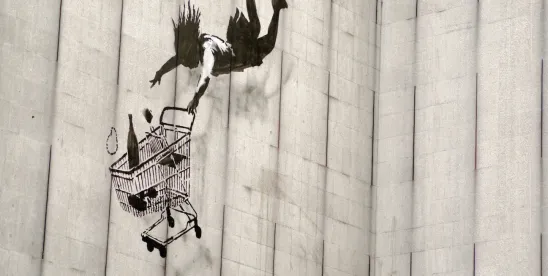
A recent 8,000-word investigation by Reuters[1] reignited one of the art world’s most persistent questions: who is Banksy? Drawing on court filings, police records, witness statements, travel data, and archival sources, the report traces the artist’s identity to Robin Gunningham. It further suggests that he may have later adopted the legal name David Jones (the second most popular name in Britain) while continuing to operate under the Banksy pseudonym.
What is notable about the Reuters piece is not just its conclusion, but its methodology for unmasking the artist. The investigation reads less like traditional journalism and more like a provenance analysis, assembling fragments of legal and factual evidence to construct authorship. In that sense, the question of identity mirrors a familiar art law exercise: establishing authenticity through documentary trails rather than direct admission.
A Market Built on Scarcity and Risk
Since 2015, Banksy’s works have generated approximately $248.8 million in secondary market sales. With transactions reaching this level, authenticity was a central concern, particularly as the market became flooded with counterfeits, including a large-scale forgery network uncovered in Italy that produced and sold fake Banksy works across Europe. Some estimates suggest that fake works may now rival or even exceed the number of genuine pieces in circulation. Losses from fraud from frauds of Banksy’s works reach into the millions each year.
Authentication as Gatekeeping
Despite renewed speculation about Banksy’s identity, the market reaction has been relatively muted. Dealers and collectors generally agree that even a definitive identification will have little impact on the value of the artist’s works. What matters is not who Banksy is, but whether or not a particular work is authenticated.
In the Banksy market, authenticity is not determined by a decentralized network of experts. Instead, it is controlled by a single entity: Pest Control Office[2], the artist’s official authentication body. Only Pest Control can issue a Certificate of Authenticity, which is effectively required for a work to be sold through major auction houses, insured, or widely accepted in the secondary market.
Because Banksy’s stencil-based works are relatively easy to replicate and highly valuable, the Certificate of Authenticity has become almost as important as the artwork itself. The authentication process requires detailed submissions and can be time-consuming, but it functions as the primary safeguard against fraud. Notably, Pest Control generally refuses to authenticate street works and certain forms of memorabilia. This reflects Banksy’s stated intention that public artworks remain outside traditional commodification.
Banksy’s centralized authentication system allows him to exert an unusual degree of control over his market and also boosts the confidence in the Banksy market. There are tradeoffs: the authentication process can be slow; there is no meaningful appeal mechanism; and the system concentrates authority in a single entity. Critics argue that this may contribute to opacity and speculation, even as it protects against fraud.
The renewed debate over Banksy’s identity ultimately highlights a deeper truth about his market. Authorship may capture headlines, but authenticity determines value. In a landscape shaped by anonymity, forgery, and institutional control, the question is less “Who is Banksy?” and more “Who decides what counts as a Banksy?”
FOOTNOTES
[1] https://www.reuters.com/investigates/special-report/global-art-banksy/
[2] https://pestcontroloffice.com/