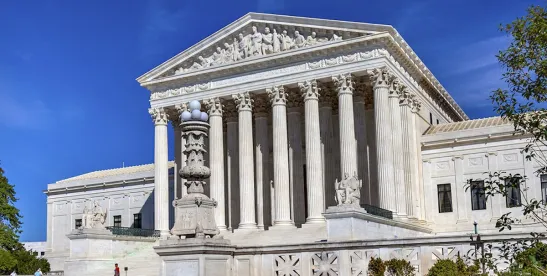
The U.S. Supreme Court agreed to review a ruling by the Colorado Supreme Court in Suncor Energy Inc. v. County Commissioners of Boulder County that allowed Boulder’s lawsuit against Exxon and Suncor Energy to proceed to trial. Like dozens of lawsuits across the country that have been filed in recent years, municipal officials in Colorado seek to hold energy companies liable for climate change caused by greenhouse gas emissions.
The Boulder lawsuit is the second climate lawsuit to survive a state supreme court ruling. The lawsuit filed by the county and city of Honolulu against leading energy producers is making its way through the state trial court, which recently denied the defendant’s motion for a summary judgment. At the start of the year, the U.S. Supreme Court declined to review the Hawaii Supreme Court’s 2023 Honolulu decision.
Nine states and dozens of municipalities have filed lawsuits in state courts against energy producers for monetary damages from the harm that climate change has caused to their communities. What critics have termed “climate lawfare” has increasingly been used as an alternative to policymaking—particularly at the federal level.
Legal analysts question the merits of these climate lawsuits that seek to keep the case in state court, as a matter of tort law. Since emissions move beyond state lines, the question of how to regulate, prohibit, or punish energy companies is a national policy issue that cannot be litigated by states.
Michael Williams, the Solicitor General of West Virginia, argues that these are questions that engage global energy markets, interstate commerce, and foreign policy—issues that must be decided at the federal level. Williams suggests that if local and municipal lawsuits are allowed to use the courts in this way “there’s going to be a Balkanization of federal energy policy.”
In granting certiorari, the Supreme Court outlined two questions for the litigants to address. The first is about timing—whether the court has statutory and Article III jurisdiction to hear the case before it has worked its way through the state court system. The more substantive question centers on preemption—whether federal law precludes state-law claims seeking relief for harms allegedly caused by the effects of greenhouse gas emissions on global climate.
Several climate cases have been dismissed by state courts on the preemption grounds, including Annapolis (MD), Charleston (SC), and the state of New Jersey. But as Professor Michael Gerrard of Columbia Law School’s Sabin Center for the Study of Climate Law notes, with Congress’ failure to set a national climate policy, “the environmental community will continue to use whatever legal levers they have.”
State courts appear to welcome the Supreme Court’s review of the Boulder lawsuit and seem content to wait for clarity on whether climate lawsuits may properly invoke the legal levers of tort law.
The Superior Court of New Jersey issued a sua sponte order in Plankin v. Exxon Mobil Corp following the announcement. The case seeks damages for climate-related harms arising from stronger storms and rising sea levels. The court has paused the state’s appeal of the 2025 dismissal and stated that “the appeal should abide the Supreme Court’s decision in In re Cty. Comm’rs of Boulder Cnty.” Similarly, in Kennedy v. Exxon Mobil Corp. in the Western District of Washington—where a proposed class action seeks to hold the fossil fuel industry liable for increased insurance premiums—the court vacated the briefing schedule for the defendants’ motions to dismiss and stayed all deadlines pending the U.S. Supreme Court’s decision on Suncor Energy’s petition.
The use of tort law to shape what many view as national policy has been criticized as an attempt to institute a de facto carbon tax, using courts to set climate policy on a state-by-state basis when Congress fails to act.
J.W. Verret suggested that the past year demonstrated a “growing judicial momentum” that respected the federal preemption argument, even with “federal courts reaching conflicting conclusions about whether state law can govern transboundary emission.” The Supreme Court’s review of Suncor Energy can bring clarity to how the preemption doctrine should direct climate litigation moving forward.
The U.S. Supreme Court will hear arguments for Suncor Energy Inc. v. County Commissioners of Boulder County in the fall of 2026.